
I Read 50 GTM Engineer Job Descriptions. No Two Described the Same Job.
Same two words. Twenty titles, five departments, a 13x salary range. GTM Engineering is not a role. It is a piece of how the whole team operates now.
If this was forwarded to you, welcome to The Sales Operator. I’m Heath, a VP Revenue who has built and rebuilt go-to-market at Uber, Airwallex, and Notch. Every week I read the field, test what holds, and share the systems I build, what broke, and what I learned. Join the operators reading it.
- I read fifty job postings for one role. Nearly every company gave it a different title and put it in a different department.
- No single duty shows up in every posting, yet most postings ask for nearly everything. It is every job at once.
- The same title pays wildly different amounts from company to company. The market has no shared definition of the job.
- GTM Engineering is not a role you hire. It is a piece of how the whole team has to operate now.
Search LinkedIn for “GTM Engineer” and you will find thousands of them. I pulled fifty of the job descriptions and read every one.
Forty-six different companies. Twenty different versions of the title. And no two of them described the same job.
That is the story. Not that the role is hot. That the role does not exist as one thing.
We keep arguing about what a GTM Engineer is, and the postings already answered: whatever the org chart could not fit anywhere else.
That posting is not a job description. It is the org chart’s junk drawer wearing a title.
What the fifty postings actually say
Start with the title. Fifty postings, twenty distinct title strings for supposedly one role: GTM Engineer. AI GTM Engineer. Founding GTM Engineer. GTM Engineer, Marketing. Senior GTM Engineer, Systems Engineering. GTM Engineer / RevOps Manager. Revenue Operations, (Sr.) GTM Engineer. GTM Engineer, Marketing Automation and Demand Generation.
When the title itself will not hold still, that is the tell.
It reads like fifty want-ads for a driver, where half the shops mean chauffeur and half mean mechanic. Same word, different job.
Then the department. The same job was filed under Marketing at Vultr, GTM RevOps at Nooks, Systems Engineering at Sanity, and Admin and Support at another.
Four postings, four different orgs, one title. Nobody agrees which function even owns it.
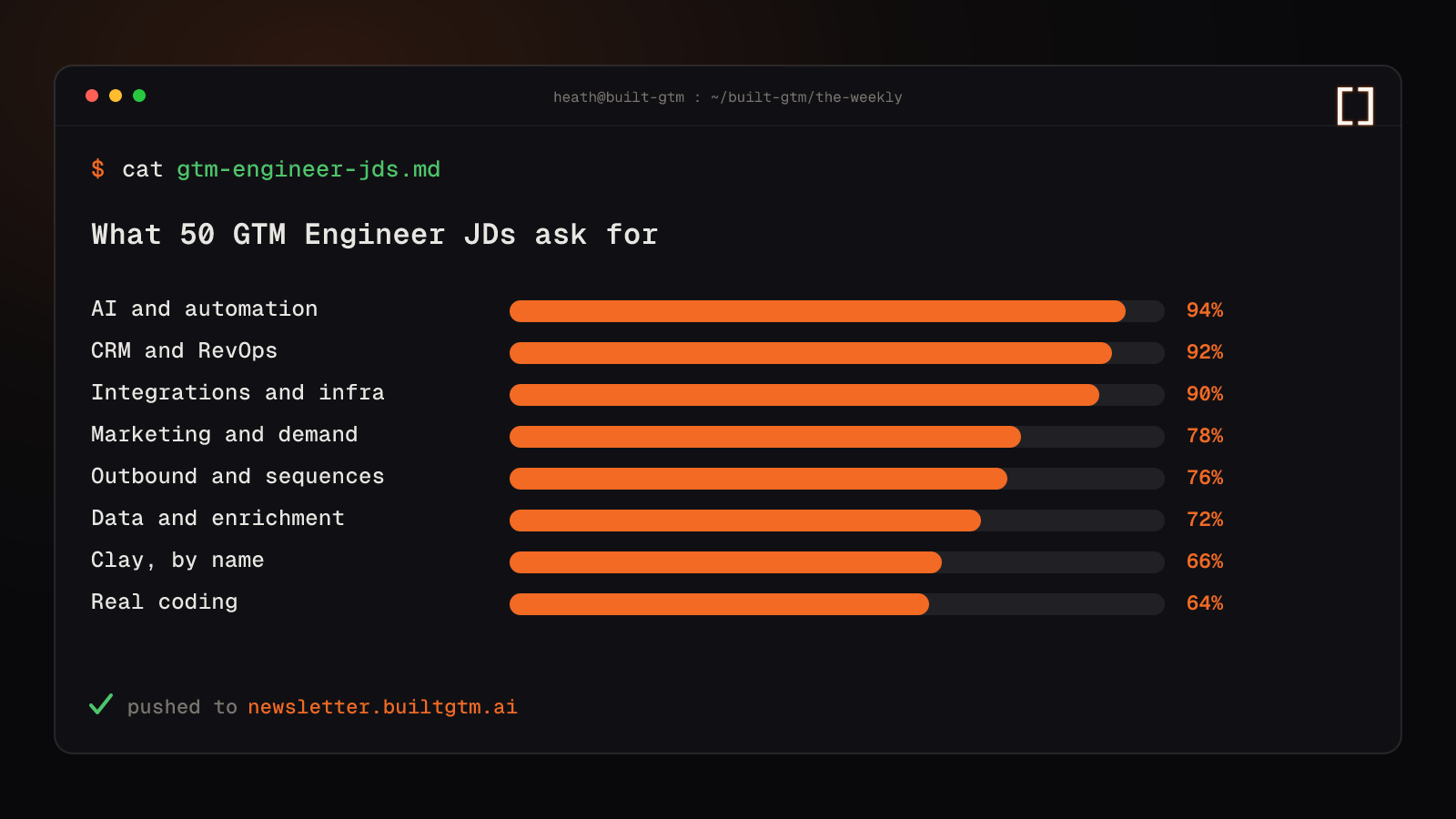
Now the work. I bucketed every posting into ten functional areas. Not one area shows up in all fifty.
AI and automation came closest at 94 percent. CRM and RevOps, the customer database and the revenue plumbing around it, at 92. Integrations at 90.
Then it fans out: marketing and demand in 78 percent, outbound in 76, analytics in 76, data enrichment in 72, Clay, one specific data tool, named by name in 66, real coding in 64, actual selling in 58.
The average posting asks for eight of the ten.
This is not a job description. It is a wish list for an entire go-to-market team, addressed to one person.
And the pay proves nobody knows what they are buying. Same two-word title, salaries from $30,000 to $400,000.
A thirteen-fold spread on one role. You do not get that range on a job the market understands.
The field is trying to define a role that is not one
I am not the only one staring at this. Read the field and you find smart people circling the same problem, each landing somewhere different.
The role is real · Kyle Poyar, GTM Engineers: Hype or Reality?
TL;DR The GTM Engineer went from non-existent to the most talked-about role of 2025, with OpenAI, Ramp, and Webflow hiring and postings surging.
My take The attention is real. The definition is not. “Most talked-about role” and “nobody agrees what it is” are the same sentence.
Here is the definition · Clay, GTM Engineering: What It Is and How to Hire
TL;DR Clay defines the GTM Engineer as an ops person turned revenue builder using AI and automation, and lays out how to hire one.
My take It is a good definition. It is also a vendor’s definition, shaped around the vendor’s tool. Fifty companies wrote fifty other ones.
Here is the pay · Apollo, What Do GTM Engineer Jobs Pay in 2026?
TL;DR Apollo pegs GTM Engineer pay at $132K to $241K, with 205 percent job growth in 2025.
My take A role growing 205 percent, with a six-figure band, that no two companies define the same way. The market is hiring a question mark and paying a premium for it.
It is not a role. It is a piece of the picture.
Here is where I land. The reason fifty postings do not agree is that GTM Engineering was never a role. It is a piece of a bigger operating model. The market is trying to buy the whole model by hiring the piece.
The lanes between titles dissolved. The org chart has not caught up. The work already has.
I wrote that in GTM Engineering Is Not a Role. It Is How You Operate Now, and the fifty JDs are the receipt for it. When the work stops fitting the titles, companies invent a new title and pile the leftover work onto it. That is what “GTM Engineer” is: the leftover work, given a name.
Half the shops want a chauffeur, half want a mechanic, and every ad just says driver.
Which is also why hiring one rarely fixes anything. As I put it in Hiring a GTM Engineer Will Not Fix Your GTM: a job req names a hire, not a problem.
You cannot hire your way to an operating model. You have to build it.
What to do instead: Solve, Stack, Split
If GTM Engineering is a piece of the model and not a person, then you stop writing the req and start running the loop on the one workflow that costs you the most.
Solve the problem. Get to the crux, not the symptom. “We need a GTM Engineer” is not a problem. “Leads leak between marketing and sales and we lose a third of them before first touch” is.
Name the workflow, framed as work.
Stack the tech. Not a shopping trip. Give that one workflow the right context: the tech that carries the data, the signals that say who matters, the brief in your voice.
This is the engineering part, and it is a capability, not a headcount.
Split the ownership. Split the drag from the judgment. The scoring, the enrichment, the first-draft prep goes to the system. The relationship and the decision stay with the human.
That is the operating model the fifty postings were groping toward, one req at a time.
The move
Do not post the GTM Engineer req yet. Take the fifty-JD test to your own team. Write down what you actually want that hire to do, and watch it sprawl across five functions.
Notice whether you are asking for a chauffeur or a mechanic. Your ad just says driver.
That sprawl is your answer. It is not one job. It is your operating model, unbuilt.
Pick the one workflow that costs the most and run Solve, Stack, Split on it this week.
GTM Engineering is not a person you hire. It is a muscle the whole team builds. Level up.
You bought the signal. You never built the motion.
Everyone can capture intent now. The pipeline leaks in the gap between knowing and acting. What I got wrong, and what I am asking Adam Robinson on air.
The Seventh Analyst: The Agent That Reads the Other Six
Anyone can stand up six AI analysts. The one that makes the system compound is the seventh, the meta-analyst that reads the others' audit trails and turns every miss into a rule the next run enforces.
The Governance File: How a Pipeline Stops Repeating Its Worst Week
When you automate, your failures go silent. This build turned every past break into an enforced gate, so a fixed bug stays fixed and nothing broken ships confidently again.