
Hiring a GTM Engineer Will Not Fix Your GTM
A job req names a hire, not a problem. Name the workflow that is bleeding you, then run the loop on it.
The first thing I want to do when GTM is breaking is add a person. It feels like progress. It is a req, a headcount, a name to blame or thank. I have done it. It is almost always the wrong move.
Hiring a GTM engineer will not fix your GTM. A job req names a hire, not a problem. The workflow that is bleeding you does not need another owner. It needs to be taken apart.
Name the workflow, not the hire
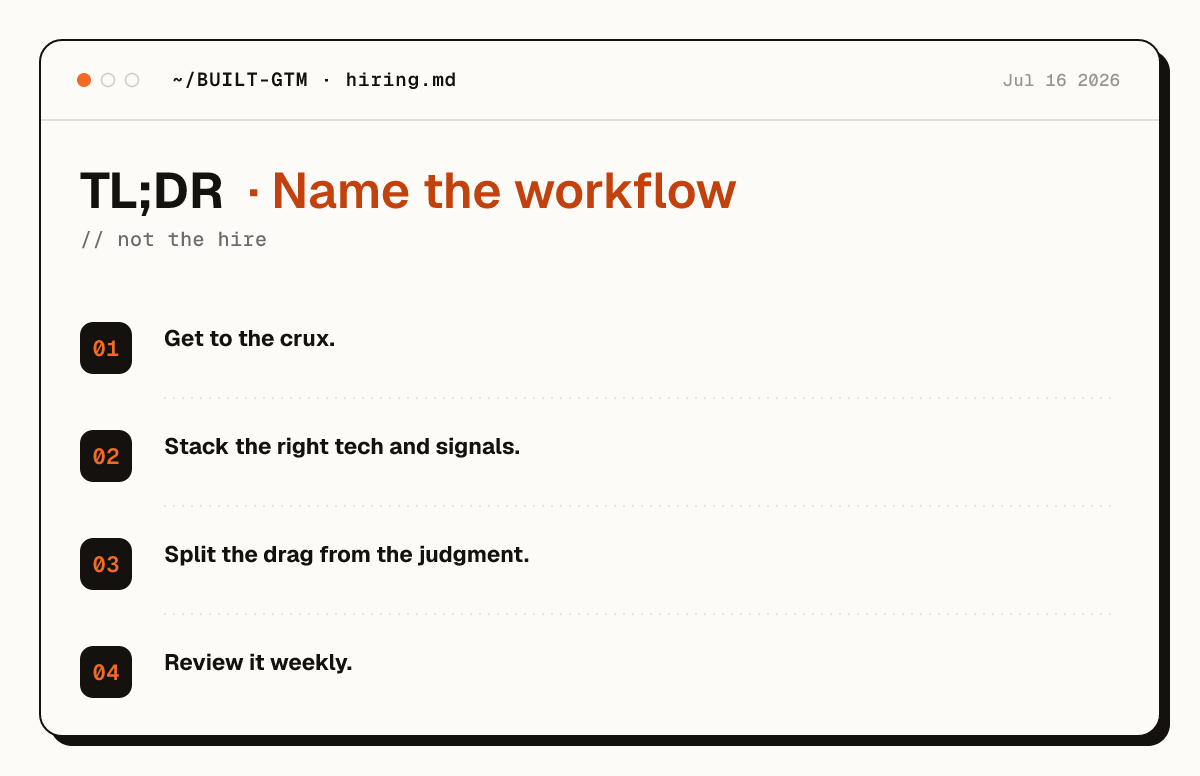
When a GTM team is stretched, the reflex is to throw a body at the number. The better move is to find the one workflow that costs you the most and frame the problem as work. Not "we need a GTM engineer." That is a category. "Inbound leaks between marketing and sales, and it costs us twelve hours a week and a third of the leads before first touch." That is a workflow. You can fix a workflow. You cannot fix a category.
Get to the crux. The symptom is "the reps are drowning." The crux is a specific thing: the reps hand-score and hand-prep every account because nothing scores or briefs it for them. Name the real one, not the loud one.
Stack the right tech and signals
Once you have the workflow, you decide what it runs on. This is not a buy-or-build shopping trip. It is about giving the workflow the right context: the tools that carry the data and the signals that tell it who and what matters. Buy the plumbing you would be crazy to rebuild. Build the thin edge that is actually yours, the scoring logic, the rules, the view. The edge is smaller than you think and it is the only part worth building.
Split the work so reps sell
Then you split the workflow. Not to automate for its own sake, but to protect selling time. The non-selling drag comes off the rep: the scoring, the enrichment, the history, the first draft of the prep. That runs before the rep opens the account. And you mark where the human stays in the loop, the call on who to pursue, the relationship, the message. The system preps. The rep decides and sells.
Where I ran this
I ran this loop across a whole GTM at Mixmax, not on a slide. The team got leaner and the numbers went up. Win rate roughly doubled. Revenue grew about 150 percent on roughly 80 percent fewer selling heads. The deal cycle got cut in half. None of that came from hiring the person I first wanted to hire. It came from picking the workflow that cost the most and running the loop on it.
What broke
The first time, I tried to fix the whole funnel at once. I learned nothing, because I could not tell which change moved which number. The loop only works on one workflow at a time. Pick the single most expensive one. Ship it. Then pick the next.
The move
Do not open the req yet. Look at your funnel and find the one seam where work crosses between functions and leaks. Size it in cost, not annoyance. Hours per week. Pipeline lost. Then run the loop on that one workflow: get to the crux, stack the right tech and signals, split the drag from the judgment, and give it an owner with a weekly review. Ship one workflow this quarter instead of automating the org chart.
The hire might still make sense later. It will make sense for a real reason, once you know exactly what the work is.
You bought the signal. You never built the motion.
Everyone can capture intent now. The pipeline leaks in the gap between knowing and acting. What I got wrong, and what I am asking Adam Robinson on air.
The Seventh Analyst: The Agent That Reads the Other Six
Anyone can stand up six AI analysts. The one that makes the system compound is the seventh, the meta-analyst that reads the others' audit trails and turns every miss into a rule the next run enforces.
The Governance File: How a Pipeline Stops Repeating Its Worst Week
When you automate, your failures go silent. This build turned every past break into an enforced gate, so a fixed bug stays fixed and nothing broken ships confidently again.