
The GTM Engineer Is Seven Jobs Wearing One Title
Six jobs before lunch. One title on your LinkedIn. The org chart is a lag indicator, and the work is already yours.
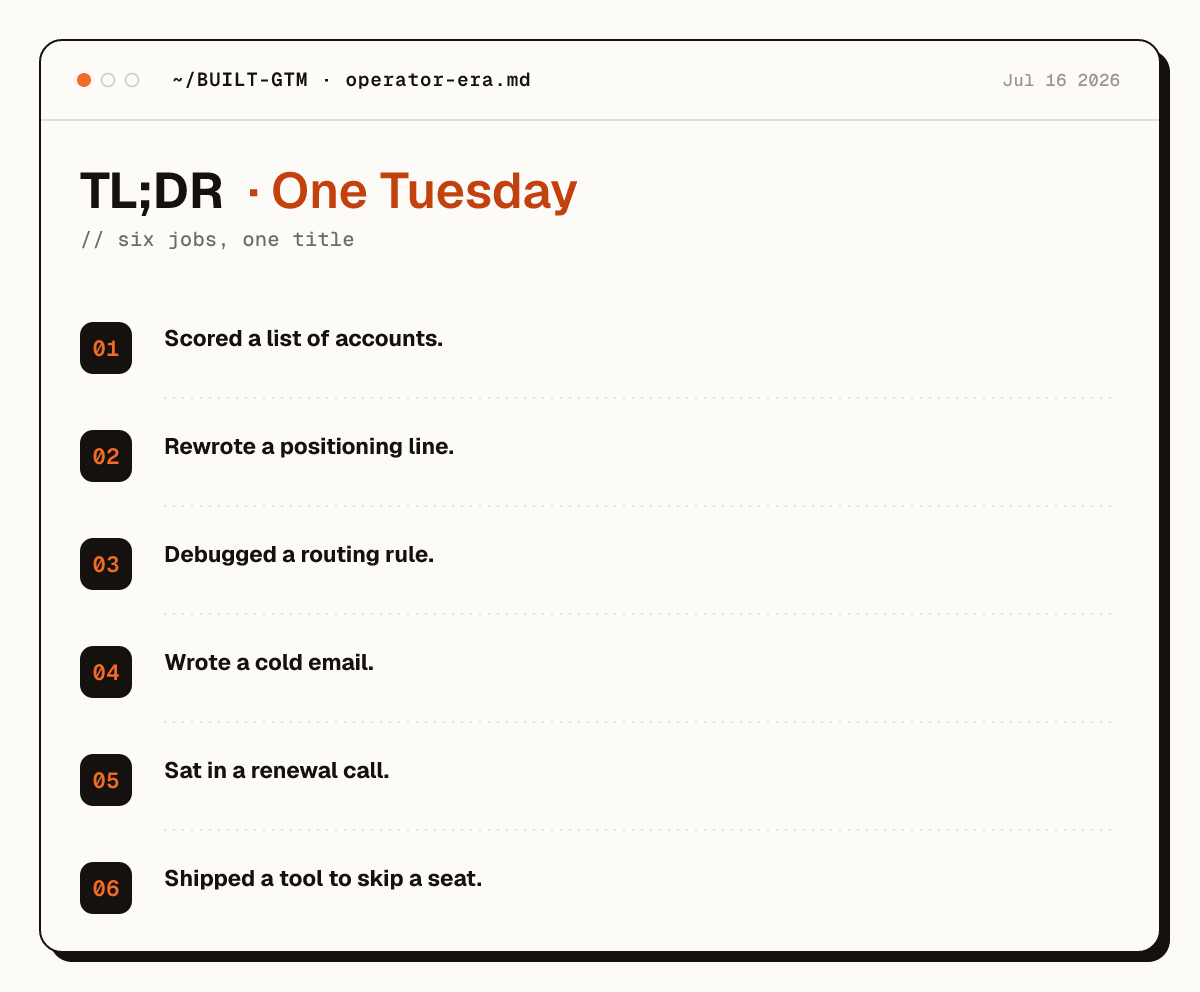
My Tuesday last week: I scored a list of accounts, rewrote a positioning line, debugged a routing rule, wrote a cold email, sat in a renewal call, and shipped a small tool to enrich a list without paying for another seat. Six jobs before lunch. One title on my LinkedIn.
The GTM engineer is seven jobs wearing one title. So is the VP of Sales, the Head of RevOps, and the CS lead. The lanes between those titles dissolved. The org chart has not caught up. The work already has.
The title is a lag indicator
Titles persist because org charts are slow. They record how work used to be divided, not how it gets done now. When someone asks what a GTM engineer is, the honest answer is not a job description. It is a list of the things that fell to whoever could do them: pipeline data, signal plumbing, the AI context that makes the tools useful, the workflow design that decides what good output looks like, and the actual selling when it comes to that.
Nobody was hired to do all of it. Someone just started doing all of it, because the work was there and the tools were finally cheap enough to build with.
The inverted week
Here is the mistake almost every operator makes, and I made it for years. The job is the 20 percent: the system design, the AI context, the workflow architecture. AI is supposed to do the 80 percent, the execution at scale. Most operators have this inverted. They spend 80 percent of the week on production work and 20 percent on the design that would make the production run itself.
I spent months blaming the model and the prompt for bad output. The real problem was that I had never structured the context the model needed. I was doing the 80 percent by hand and wondering why the 20 percent never got done.
Where AI helps
AI is very good at the 80 percent once the 20 percent exists. Give it a real ICP definition, a positioning house, and a voice guide, and it will write the account brief, score the list, and draft the first touch at a quality you could not hit by hand at that volume. The gain is real. It is also downstream of the design.
Where AI hurts
AI makes the inverted week worse if you skip the design. It lets you produce more bad output faster. A team with no context and a pile of AI tools does not get smarter. It gets busier. Activity goes up and intelligence stays flat. More output is not more signal.
Where AI optimizes
The middle ground is the one that pays. You do the 20 percent once, and you store it so the system runs the 80 percent every day. Define the ICP. Write the positioning. Set the voice. Put it somewhere the tools can read. Then the same design compounds across every campaign, every rep, every new hire who opens the repo on day one and already knows the ICP without a single onboarding call. That is the whole idea behind building your operator system, and it is where the leverage lives.
The move
Stop describing yourself by your title. Look at your last Tuesday and count the jobs. Then pick the one design decision, the ICP, the context, the workflow, that would let a system do the version of that work you are currently doing by hand. Do that one thing this week.
The title will catch up later, or it will not. The work is already yours. GTM has evolved. Time to operate accordingly.
You bought the signal. You never built the motion.
Everyone can capture intent now. The pipeline leaks in the gap between knowing and acting. What I got wrong, and what I am asking Adam Robinson on air.
The Seventh Analyst: The Agent That Reads the Other Six
Anyone can stand up six AI analysts. The one that makes the system compound is the seventh, the meta-analyst that reads the others' audit trails and turns every miss into a rule the next run enforces.
The Governance File: How a Pipeline Stops Repeating Its Worst Week
When you automate, your failures go silent. This build turned every past break into an enforced gate, so a fixed bug stays fixed and nothing broken ships confidently again.