
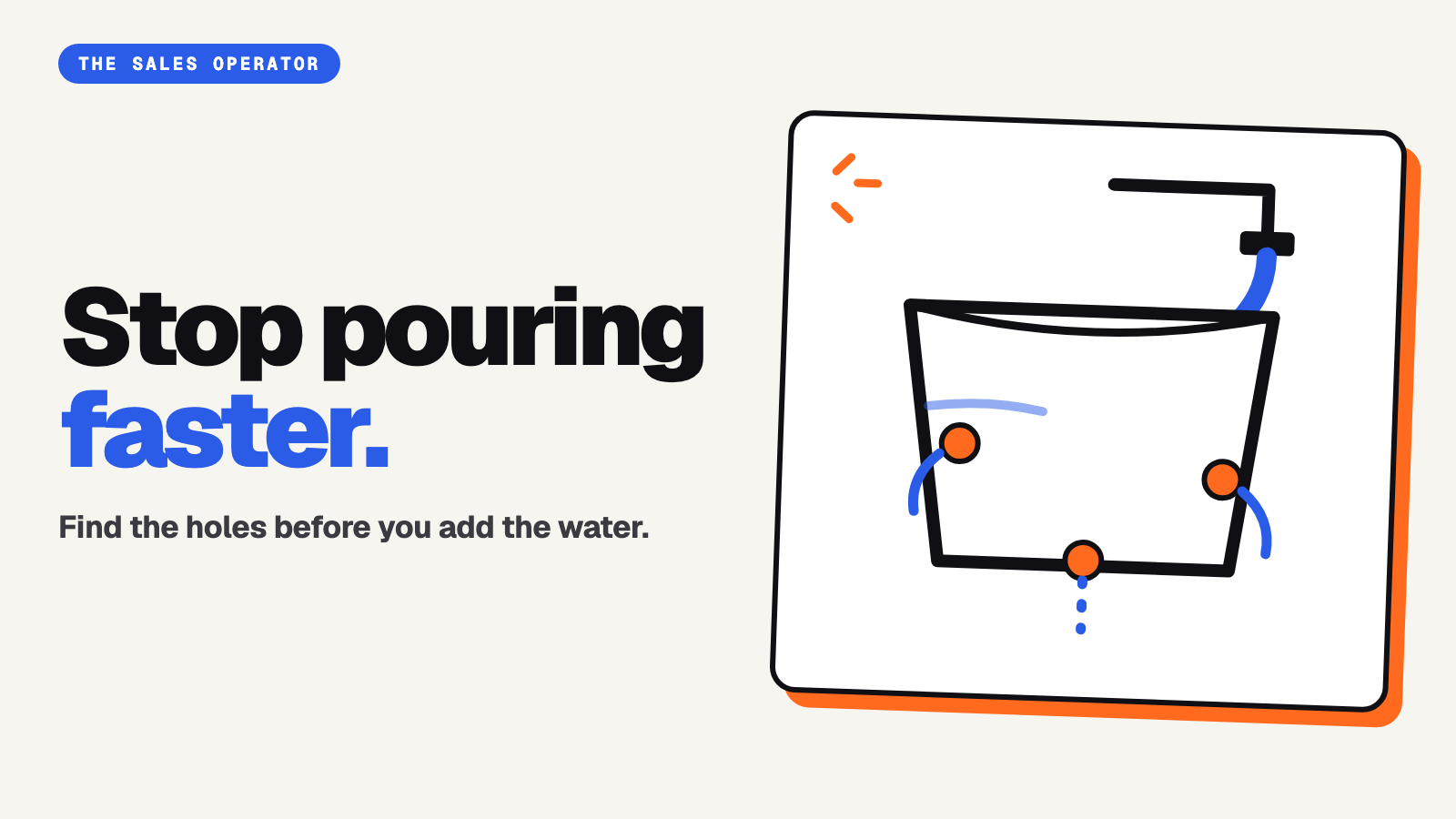
Stop pouring faster
When the number is short, the default plan is to add. Follow the water first. Three holes, one tap, and a check for each you can run today.
I left my last role in August and took the summer off with my girls. They're five and three, so "off" is generous.
Stepping back, one pattern stood out. When the number is short, the default plan is to add. More reps, more SDRs, more pipeline.
I get why. Headcount is the easiest lever to tie to revenue. Add ten reps at quota and the forecast goes up.
I've never had that budget. Every plan I've run was a tradeoff, and at my last company I moved headcount budget over to tech. When you can't pour faster, you have to find where the water's going.
Follow the water
Before you add anything, trace one number all the way to the customer. Most dashboards stop at closed won. The water keeps going, and it leaks where nobody's looking.
Every time I've followed it, I've found three holes and one tap.
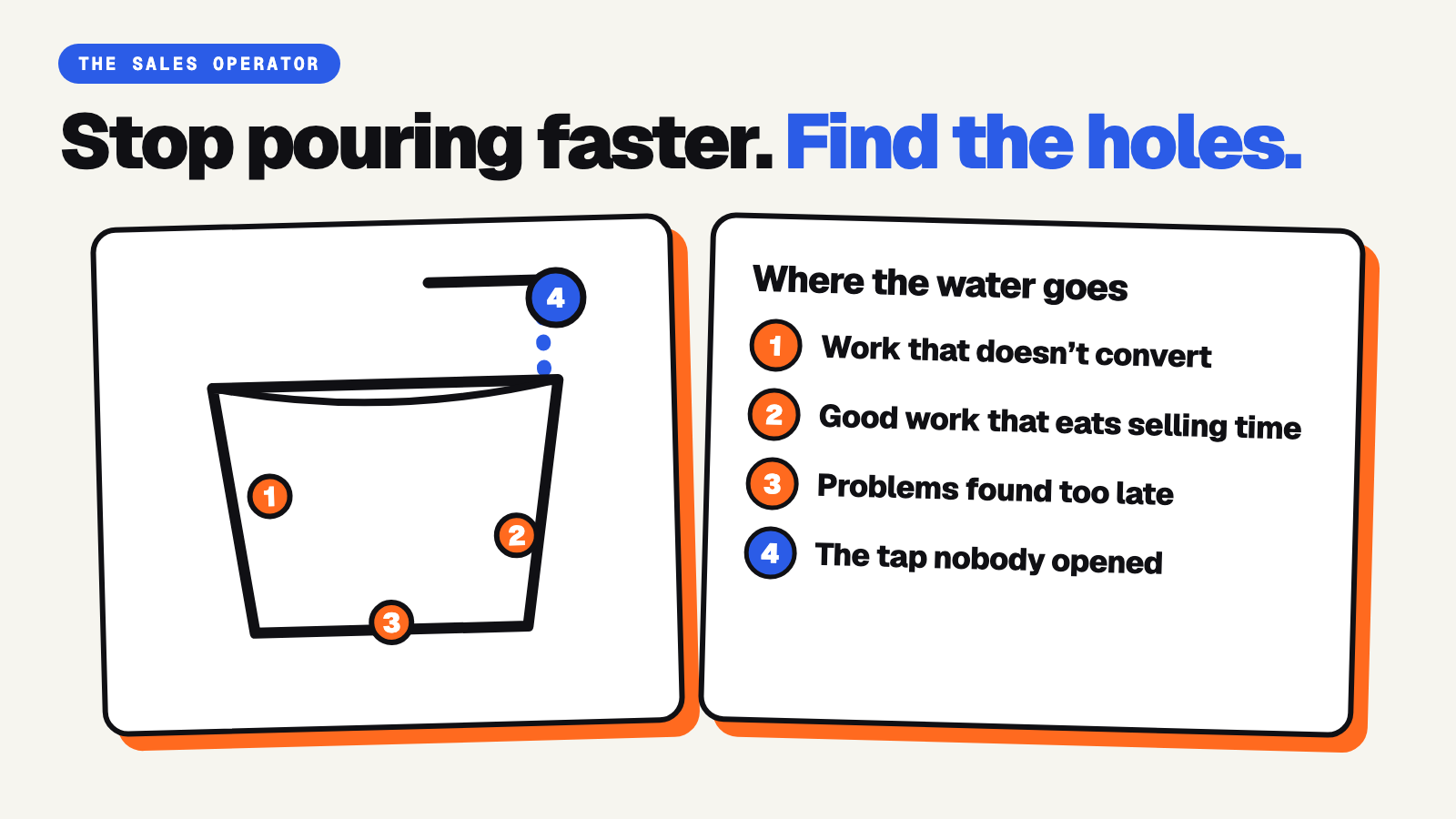
Hole 1: Work that looks good and doesn't convert
Everyone wanted to promote our top SDR. Most pipeline on the team, month after month.
So I followed it. Lowest win rate on the team, smallest deals, highest churn. We built that scoreboard. They just won it.
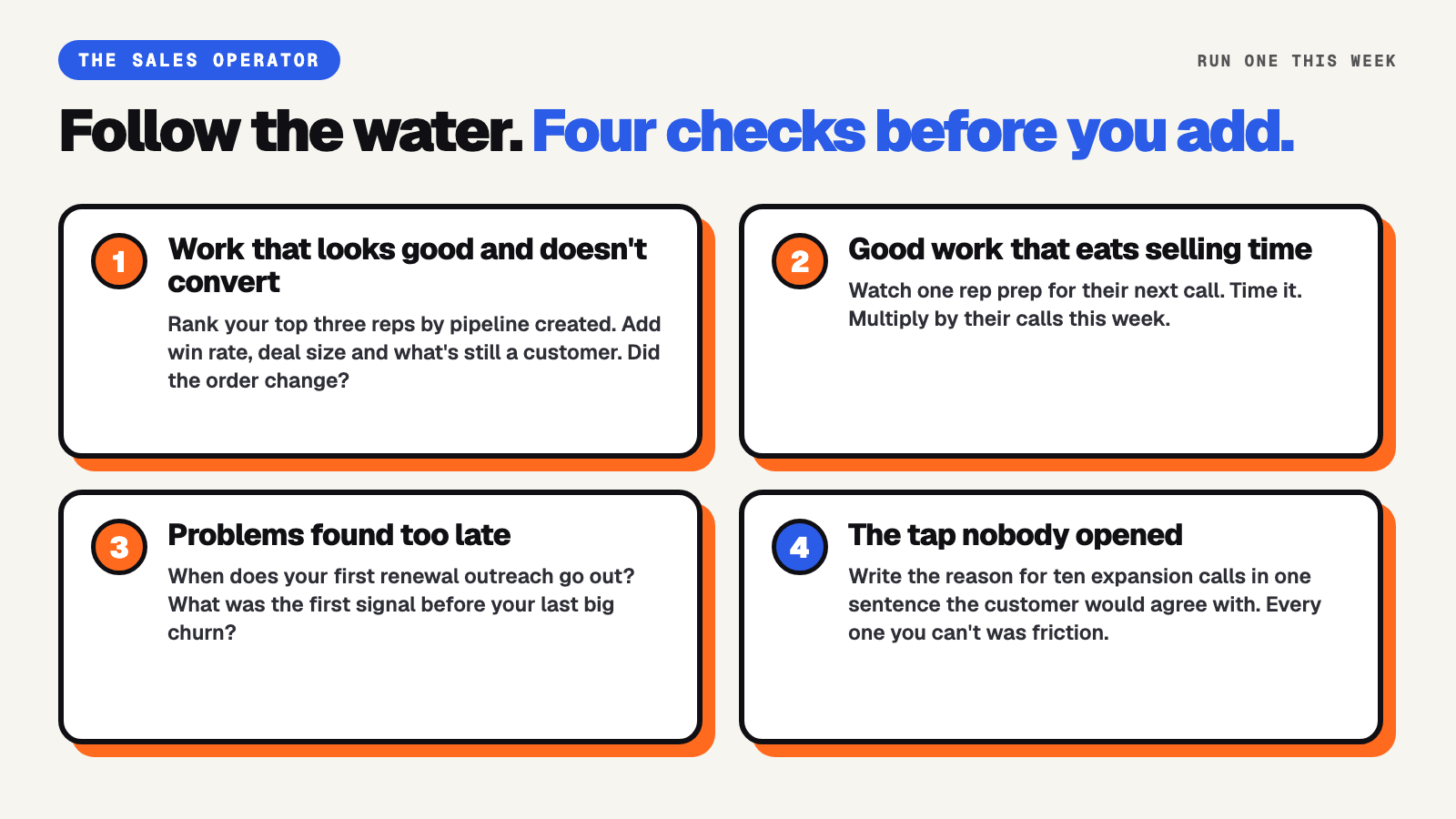
Check it today: Rank your top three reps by pipeline created. Add their win rate, deal size and how much of it is still a customer. If the order changes, you're counting the wrong thing.
Hole 2: Good work that eats selling time
I had a rep share their screen and walk me through their pre-call research. Watching it live, I saw how much time quality took. Every account, every call.
Nobody flags work that's done well. But every hour in research was an hour not selling. So I built a swarm of agents to score the accounts, prioritize them, write the account plans and suggest the messaging and sequencing. That time went back to buyers.
Check it today: Watch one rep prep for their next call. Time it. Multiply by their calls this week.
Hole 3: Problems found too late
One of the hardest conversations I had with my team was about a large customer that had just churned. Looking back, we could have seen it six months earlier. They'd been all over the competitor pages and the pricing page on our site.
Our first renewal outreach went out 60 days before the date. By then, a leaving customer has been shopping for months. So we studied what healthy accounts did in the product that leaving ones stopped doing.
Check it today. If you can't answer these, go back to the drawing board:
- When does your first renewal outreach go out?
- What was the first signal before your last big churn?
- What do healthy accounts do that leaving ones stop doing?
- Who sees it when a customer visits your pricing page?
The tap: growth already in the building
Thousands of people used our product every week. Nobody in sales knew, me included.
My first try was handing a rep a list of active accounts. That's surface level. It just throws activity at customers, and calling a customer with no reason creates friction in a relationship that's working.
So I treated it like outbound. No reason, no conversation. We mapped the product actions that came before growth, and a rep only called with that signal in hand. It became our best channel. Nearly half the deals it opened were won.
Check it today: Take ten expansion calls from last month. Write each reason in one sentence the customer would agree with. Every one you can't write was friction.
Before you add anything
None of these four started with a new rep. They started with looking.
Pick one hole, run its check this week and fix it before anyone asks for more headcount.
We scale by adding because we never learned to fix. So, where does your water actually go?
It's a wrap, Boston
They walked in willing. They walked out capable, with a live campaign and a list of questions. Here's what that room taught me.
Your ICP Doc Is Fine. Two Things Broke.
Forwarded to you? I am Heath. I am a Sales Operator: I run the system, the team and the deals at once, and I
Right seat, not the next rung
Most teams reward one number and offer one path up. The best leaders put people in the right seat, not just the next rung, and develop them in a fixed order.