
Right seat, not the next rung
Most teams reward one number and offer one path up. The best leaders put people in the right seat, not just the next rung, and develop them in a fixed order.
Earlier this month I officiated my first wedding, in the mountains of Colorado, for my sister-in-law. Our daughters were the flower girls.
Before the ceremony, she told me why they asked me to stand up there. I had watched them grow. Of everything said that day, that's the line I keep coming back to.
Because that's the job at work, too. Not deciding who's next up the ladder. Watching people closely enough to know which seat they'll grow best in. This one is about the times I got that right, and the times I didn't.
TL;DR
- Most teams reward one number and offer one path up. The loudest number wins, and the next rung is the only prize.
- The best leaders put people in the right seat, not just the next one. Sometimes that seat is sideways.
- Development runs in one order: explain why, show what good looks like, show it, coach it, give room, hold it accountable.
- AI can find the gap in someone's work. It cannot have the conversation about it. That part is still yours.
The move everybody makes first
When a team falls short, most leaders reach for the same two things. A slide that says "on track." And a promotion for whoever topped the board.
It happens in every seat. The best AE becomes the sales manager. The best renewal rep becomes the head of CS. The best writer on the marketing team becomes the team lead.
Nobody asks if that seat fits. The ladder only goes one way, so that's the way everyone climbs.
The ladder is not a career path. It is one seat everyone is told to want.
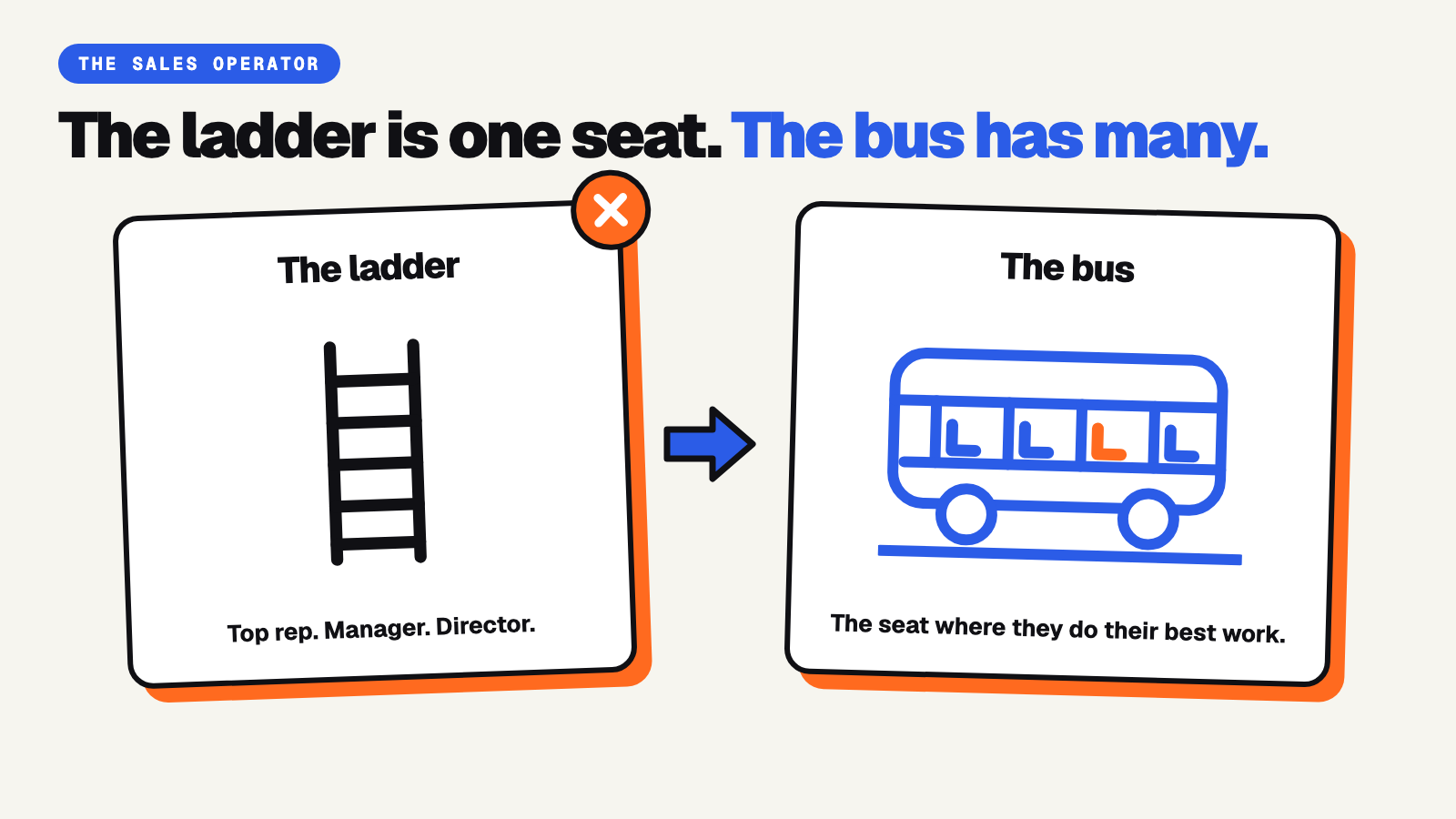
I've climbed it, and I've pushed people up it. Here are two times it went wrong.
The first was a top SDR. Most pipeline on the team, month after month. Everyone wanted them promoted into an AE seat, and the ask landed on my desk early.
So I followed where that pipeline went. It had the lowest win rate on the team, the smallest deals, and the highest churn. On the number we celebrated, they were our top performer. On the numbers that mattered, they were our lowest.
Telling the team was the hard part. Everyone was shocked, and I understood why. We built the scoreboard. They just won it.
The second was a sales manager. For this piece, I'll call them Joe. Great at setting expectations, great at holding people accountable. But Joe's team wasn't growing, and every week the story was "this rep isn't doing this."
We put Joe on a 30-day coaching plan, the same way I'd coach a rep. Then we got candid. Joe had assumed sales management was the only way up, so that's where Joe went.
Joe had every quality of a great operations leader. So that's where we made the move, and Joe kept growing. Both times the person was fine. The seat was wrong, and so was the scoreboard I'd built.
So what was actually broken?
Not the people. The bus.
Jim Collins made the line famous: get the right people on the bus, and in the right seats. Most of us only remember the first half. We hire well, then point everyone at the same seat near the front.
I call the fix right seat, not the next rung. It means you stop asking "who's next for the ladder?" and start asking "where does this person do their best work?"
That question needs two things before it works. A clear picture of the seat. And a person who has been shown, coached, and given room to prove they belong in it.
So here is the order I develop people in, every time:
- Explain the why. Why this seat exists and why it matters now. People own what they understand.
- Define what good looks like. The written bar for the seat they're in and the one they want, before anyone is judged.
- Show it. Model the work first, and say why behind each move.
- Coach it. Weekly, candid, on the one thing that matters most.
- Enable it. Give them the room. Real ownership, with you out of the way.
- Make it accountable. Against the bar, out loud, with a date. Next seat, a dated plan, or a different seat.
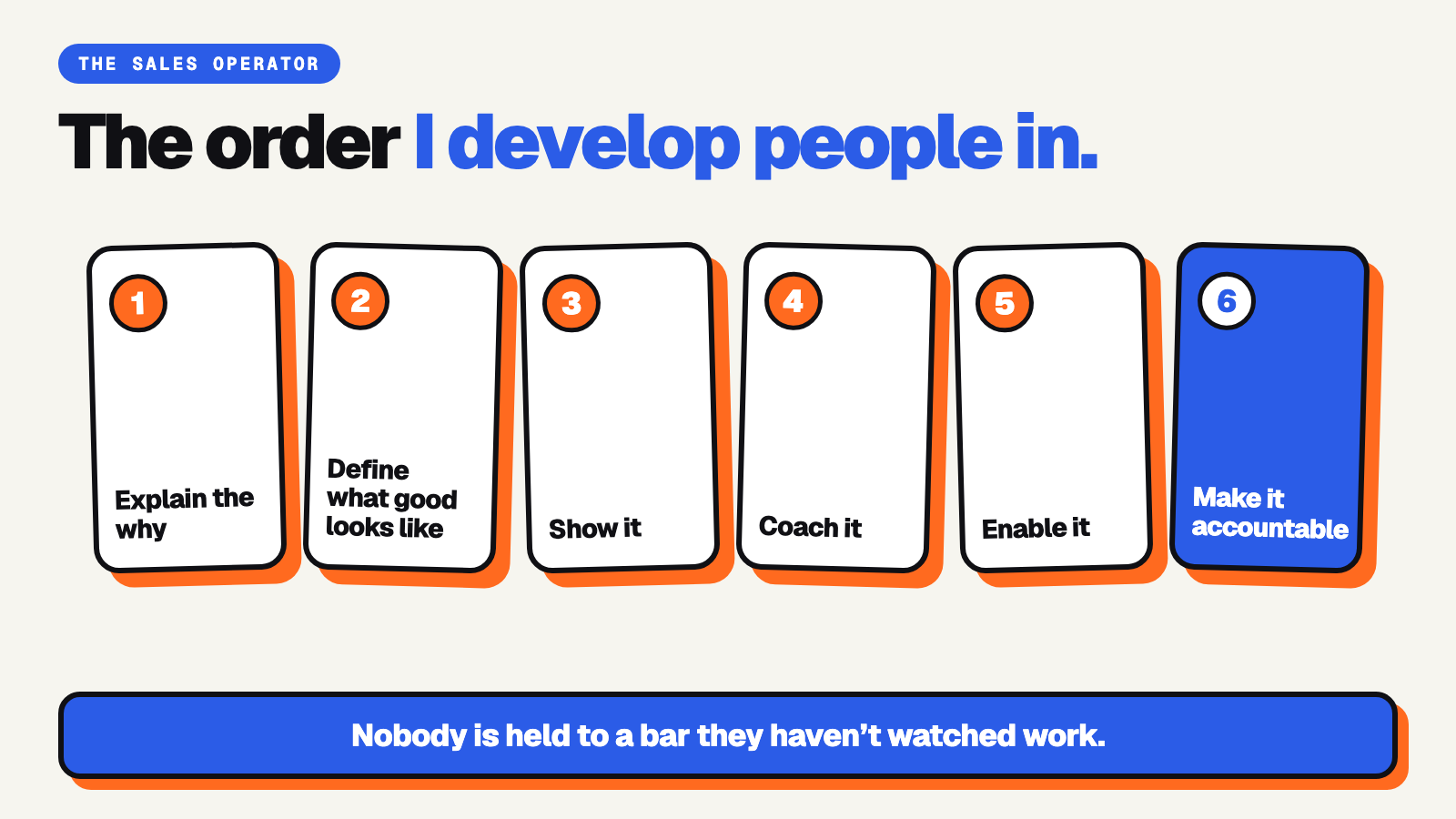
Coach up or coach out. And out doesn't always mean out the door.
The same move works in every seat. A CS leader looks at their best renewal manager and asks if they love the customer or the spreadsheet. A marketing leader looks at their sharpest writer and asks if they want a team or a byline. The answer decides the seat, not the org chart.
What other people are saying about this
Jim Collins: Good to Great
What it argues. Great companies decide "who" before "what." They get the right people on the bus, the wrong people off, and the right people into the right seats, then figure out where to drive.
My take. I took the seat half from Collins and it changed how I run every performance conversation. Where I'd push further is the middle option. Between "right seat" and "off the bus" there is usually a better seat on the same bus. Most leaders skip it because it takes a harder conversation than a promotion or an exit.
Laurence J. Peter: The Peter Principle
What it argues. In a hierarchy, people get promoted for doing their current job well. They keep rising until they land in a job they can't do, and they stay there.
My take. Sales is a textbook case. A great rep becomes a struggling manager, and the team loses its best seller and gains a frustrated leader. What I'd add is that it isn't destiny. Show the next seat before you promote into it, and people can find out early if they want it.
Kim Scott: Radical Candor
What it argues. Good feedback means caring personally and challenging directly at the same time. Caring without challenging is ruinous empathy, which she calls the most common mistake managers make.
My take. This is the standard I hold every coaching conversation to, and it's hers, not mine. Where I'd extend it is to the room, not just the one-on-one. When the all-hands slide says "on track" and everyone knows it isn't, that's ruinous empathy. It just happens at the scale of a whole team.
Charles Goodhart: Goodhart's law
What it argues. When a measure becomes a target, it stops being a good measure. People optimize the number, not the thing the number was meant to show.
My take. My top SDR is Goodhart's law with a name and a face. We made pipeline the target, and they hit it perfectly. The lesson I took is to never celebrate a number I haven't traced all the way to the customer.
The five steps, in order
This is the team half of how I work, which I call RAISE. Each letter is a plain question.
R: Recruit the profile, don't profile the recruit
Do you know what good looks like before the interview starts? Write the bar for the seat first, then hire to it. The same goes for promotions: write the next seat down before you decide who fills it.
A: Anchor the standard
Is there one way the team works? The playbook, the ramp, one source of truth. Without an anchor, every coaching conversation is an opinion, and every "you're not ready" sounds personal.
I: Inspect the work
Are you looking at the work or the person? Look to coach, not to catch. For an AE that's the deal. For a CSM it's the account plan. For a marketer it's the campaign brief.
S: Sharpen the coaching
Is this week's coaching on the one gap that matters? Not five metrics. One crux, the single thing holding the result back, coached until it moves.
E: Earn the forecast
Can you defend the number? A forecast you earned has a reason behind every deal. A team you earned has a reason behind every seat.
What I saw
The pricing test nobody had to be told about. At a company I was at, we were redoing pricing and packaging. Then tech debt pushed the roadmap back about six months.
I didn't want to wait. I wanted to test one question early: was our pure per-license pricing slowing down negotiations? So we tested a new platform and product-based price on live deals.
I could have announced it top-down and told the team what to do. But that isn't how I lead. So I started with the why: what we were testing, and why it mattered now.
Then I showed it. I ran the demos. I led the negotiations. I co-ran every deal with my reps, so they saw what good looked like before anyone asked them to do it.
I coached in real time. Right after each call, we talked through what worked and what didn't, and what we learned.
Once we saw it working, we built the enablement properly. Deals closed bigger, and time in the negotiation stage dropped 20%+.
Only then did we change how we held deals accountable, and how we forecast. The order mattered. Nobody was held to a pricing motion they hadn't watched work first.
Where it might not transfer. I could co-run every deal because the team was small. With fifty reps, you'd show it with a few, and let them show the rest.
The quintile report. When I was scaling a team, the hardest problem wasn't low performers. It was managers who talked about their low performers and never to them.
So every month, every rep was ranked against their peers on the outcomes that mattered, in five equal groups. Each manager walked me through their bottom group. What's the coaching plan? What's the risk if it doesn't work?
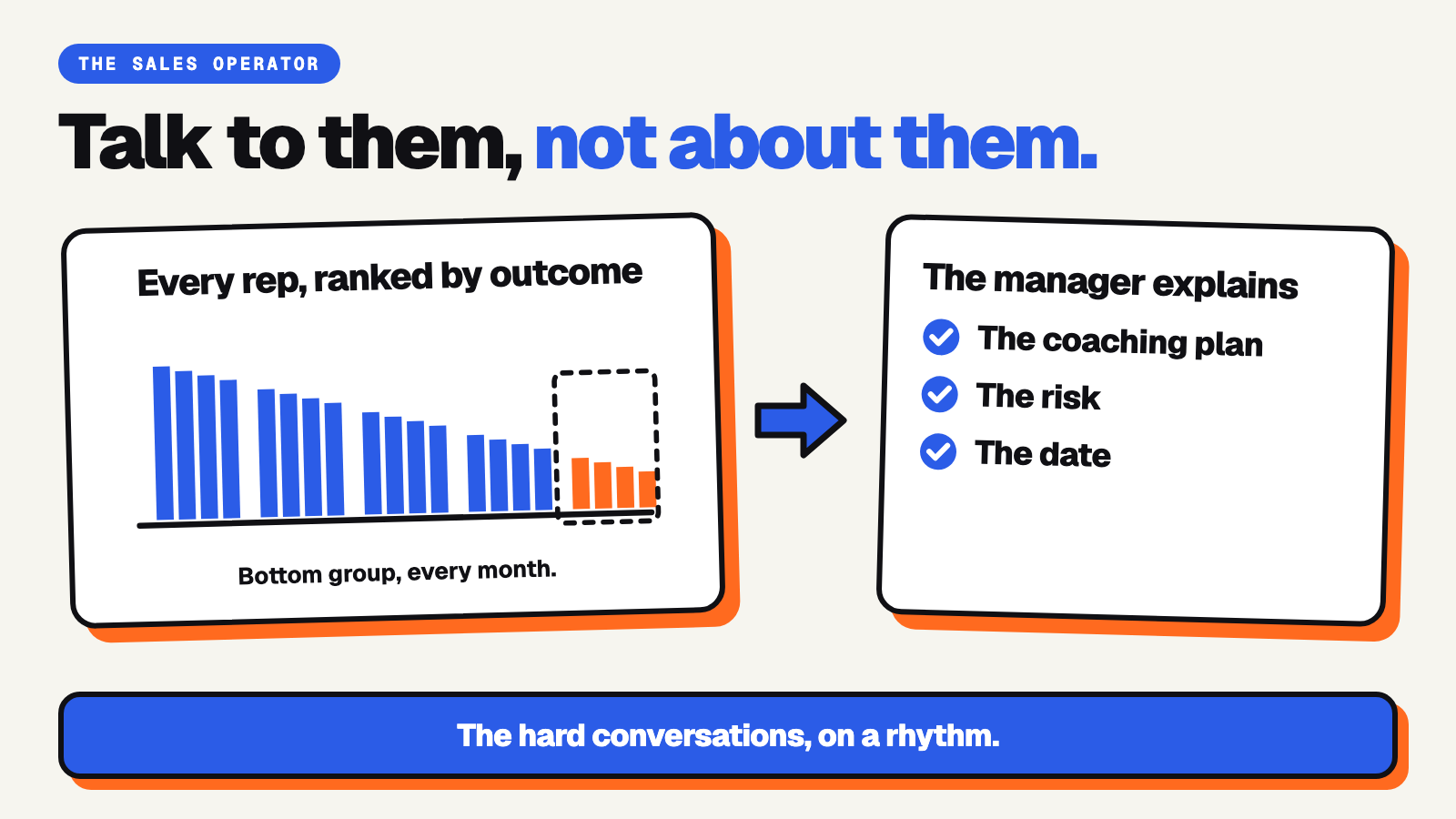
It put the hard conversations on a rhythm. A manager can't sit on a struggling rep for six months when they explain the plan every month. When I first started using it, we watched the gap between each cohort close. It also made it much more obvious who needed coaching up, and who might need coaching out.
The 30-day reset. At a company I was at during a turnaround, I had to reset a whole team on outcomes instead of activity. I told everyone where we were, where we needed to be, and how we'd get there. Then thirty days of coaching and enablement. At day thirty, everyone got a growth plan, a coaching plan, or a different path.
Nobody was surprised by where they landed, because they had seen the bar every week. That's the whole point of the order above.
Where this might not transfer. Moving someone sideways needs a sideways seat to exist. In a five-person startup there may be no operations team to move into. Then the honest answer is a candid conversation about fit, sooner, not a seat you invent.
Drop your own team in. Look at your top three performers and ask which number made them top. Then follow it to the customer.
What I learned, and what I have not
- Trace the number before you celebrate it. My top SDR taught me that a scoreboard can be perfectly accurate and completely wrong.
- The right seat comes before the exit. Joe taught me that "coach out" usually means out of the seat, not out of the company.
- Say "we got this wrong" out loud. Everyone already knows what happened. The leader who names it first is the one who keeps the room.
- Nobody should be surprised by a promotion or an exit. If they are, the coaching wasn't candid enough, and that part is on me.
- The part I have not worked out. AI can now find the gap in someone's work and suggest how to coach it. I build those tools. And I'm watching managers hand the AI's answer straight to the rep instead of building the plan with them. I don't know yet how the next wave of managers learns the conversation part. The tool did the thinking before the one-on-one even started.
The move
This week, pick one person on your team who is climbing a ladder. Ask them, plainly, if it's the seat they want. Then listen longer than feels comfortable.
Two pieces that sit next to this one. RAISE, the full version of the five steps: "Most people problems are missing-anchor problems." And The Seventh Analyst, on a different kind of team: "six analysts that never learn is not a team, it is the same mistake hired six times."
So: who on your team is climbing a ladder they never wanted to be on? If you can't answer that, you may be the one holding the ladder.
You bought the signal. You never built the motion.
Everyone can capture intent now. The pipeline leaks in the gap between knowing and acting. What I got wrong, and what I am asking Adam Robinson on air.
The Seventh Analyst: The Agent That Reads the Other Six
Anyone can stand up six AI analysts. The one that makes the system compound is the seventh, the meta-analyst that reads the others' audit trails and turns every miss into a rule the next run enforces.
The Governance File: How a Pipeline Stops Repeating Its Worst Week
When you automate, your failures go silent. This build turned every past break into an enforced gate, so a fixed bug stays fixed and nothing broken ships confidently again.