
Millions in pipeline, with a GTM team of two
Elina Papernaya built a multi-million dollar pipeline at Alta without scaling headcount. She is joining me Wednesday to take apart exactly how.
Most teams answer a stretched quarter the same way. Add a role. Right now that role is the GTM Engineer, the hire who is supposed to wire the tools and automate the machine.
A new role is not a plan. It is a gap wearing a job title.
Elina Papernaya did the opposite.
She is Head of GTM at Alta, an AI-native revenue platform out of Tel Aviv. AI-native meaning built around AI from the start, not bolted on after.
She has built a multi-million dollar pipeline with a GTM team of one to two people. Not by hiring. By designing the work first, then stacking the tech around it.
That is the entire argument of this episode, already running in production at somebody else's company.
I have made the case before that GTM engineering is not a role, it is how you operate now. And when I read fifty GTM Engineer job descriptions, no two described the same job.
Those pieces argue the point. Elina is the proof.
The loop underneath it
What she is running, whether or not she calls it this, is one loop with three moves. You run it on the workflow that costs you the most.
Solve the problem. Build the workflow. Not the org chart, not the tool list.
The actual sequence of steps a person is doing today, written down honestly.
Stack the tech. Buy the plumbing. Build the edge.
Most teams do this backwards. They build the plumbing everyone else already sells, and buy the thing that was supposed to be their advantage.
Split the work. Cut the drag to the machine. Keep the judgment with the people.
The goal is not fewer humans. It is humans doing the part only humans can do.
The loop is fractal, the same shape at every size. You never run it on the org. You run it on a workflow.
A big transformation is the same loop repeated on the seams.
I ran it on my own rep brief before I ran it on anything bigger. And the last two years taught me the version I trust.
We took a team leaner than felt comfortable and still outproduced the historical numbers. A slow kitchen does not need another cook. It needs the recipe fixed and the counter cleared.
Headcount was never the constraint. Design was.
What Elina and I are digging into
We are going to get specific, because this argument dies without specifics.
Where AI SDRs actually earn their keep, and where they fall over. An AI SDR, in plain terms, is a software agent doing the prospecting a junior rep would do.
What she chose to build versus buy. What she deliberately keeps with people.
And the part most teams skip, how a small team decides what not to do at all. The smallest kitchens run the shortest menus on purpose.
If you want her thinking before Wednesday, she talks about it on the RevOps Venture podcast and writes about the AI SDR motion on the Alta blog.
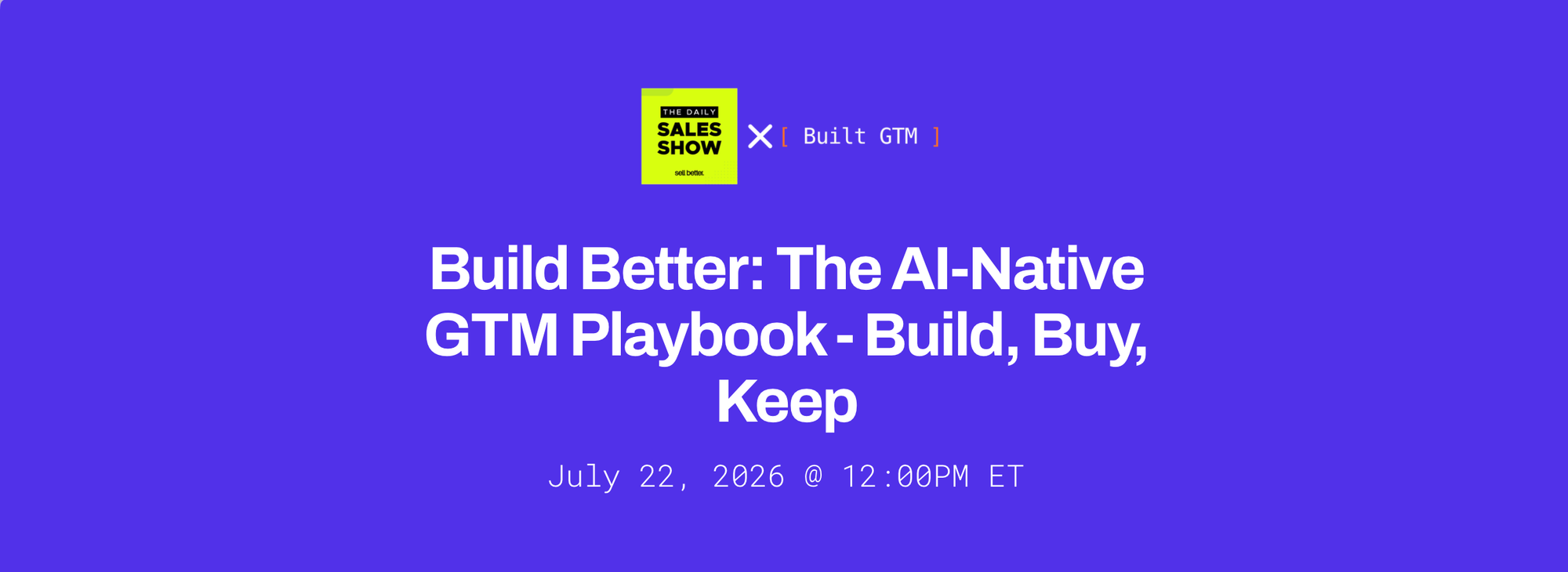
The details
The Daily Sales Show x The Sales Operator.
Build Better: The AI-Native GTM Playbook. Build, Buy, Keep.
Wednesday July 22, 12:00PM ET.
Bring the workflow that is costing you the most. That is the one we are going to work on. Fix that recipe before you hire another cook.
You bought the signal. You never built the motion.
Everyone can capture intent now. The pipeline leaks in the gap between knowing and acting. What I got wrong, and what I am asking Adam Robinson on air.
The Seventh Analyst: The Agent That Reads the Other Six
Anyone can stand up six AI analysts. The one that makes the system compound is the seventh, the meta-analyst that reads the others' audit trails and turns every miss into a rule the next run enforces.
The Governance File: How a Pipeline Stops Repeating Its Worst Week
When you automate, your failures go silent. This build turned every past break into an enforced gate, so a fixed bug stays fixed and nothing broken ships confidently again.